

Somaliland: a Key Piece in an Imperial Game.
- Al Johnson

- Mar 13
- 15 min read
It's all about routes and resources.
Initially posted on HistoryDA on Substack, Feb 20, 2026. https://historyda.substack.com/p/somaliland-a-key-piece-in-an-eternal
Despite Western support for the self-declared breakaway republic since 1991, it took over 30 years for another nation to officially recognize it.
Almost immediately, there were claims that this was “unusual” or “unprecedented”. Many others could not understand why anyone would be interested in or recognize Somaliland, especially when it could potentially give fuel to other separatist movements in Africa.
Since our catchphrase seems to have become “Nothing New Under the Sun”, we again will show why Somaliland, and the region it sits in, has been in the crosshairs of global empires for 2000 years, and why Somaliland and Somalia, have a long history of being colonial concerns, starting with Ancient Egypt and eventually becoming the focus of Rome, Islamic, Ottoman, British, Russian, American and Israelis.
Ancient Foundations: The Eternal Allure of the Crossroads (c. 2500 BC–7th Century AD)
EGYPT
Our investigation begins in the mists of antiquity, where Somaliland emerges as a prime example of eternal geopolitical vulnerability. Dubbed part of the “Land of Punt” in Egyptian hieroglyphs, this coastal strip—home to ports like Malao (modern Berbera) and Avalites (near Zeila)—was a treasure trove of myrrh, frankincense, ebony, gold, and exotic beasts. Pharaohs like Hatshepsut (r. 1479–1458 BC) dispatched fleets to exploit their Red Sea perch, illustrating a pattern: wealth from trade routes lures competing empires, and measures by controlling one to exert more control. However, local Cushitic nomads (proto-Somalis) appear to have clung to clan-based autonomy and kept Egypt at bay.
ROME
The initial pressure on resources from Somaliland took the form of demand in the Mediterranean region for the treasures of Arabia and the Punt region. Hellenic and Roman merchants ramped up trade, and the expanding Roman civilization created greater demand. By the 1st Century AD, a growing trade network across Somaliland made it a region of importance to Rome. Rome has developed an intercontinental trade network. Exchange with kingdoms in what is now Indonesia, India, multiple Central Asian Republics, and CCP Occupied Asia was established and maintained. While the Roman Roads get most of the publicity, the real economic driver was the sea lanes. It cost less to move grain by sea from Africa to Europe for the Romans than it did in some cases between cities in Gaul by road. An excellent text—the 1st-century AD Periplus of the Erythraean Sea (Indian Ocean) —provides a record of bustling international trade hubs exporting cinnamon, slaves, and incense for Roman luxuries.

Photo: Abraham Ortelius (1527-1598) Cover for reprint of the 1st Century Erythraei sive Rubri Maris Pariplus. From Periplus Archao Cosmos website. https://periplus.arch.uoa.gr/texts/peripl_erythr/intro_en.html
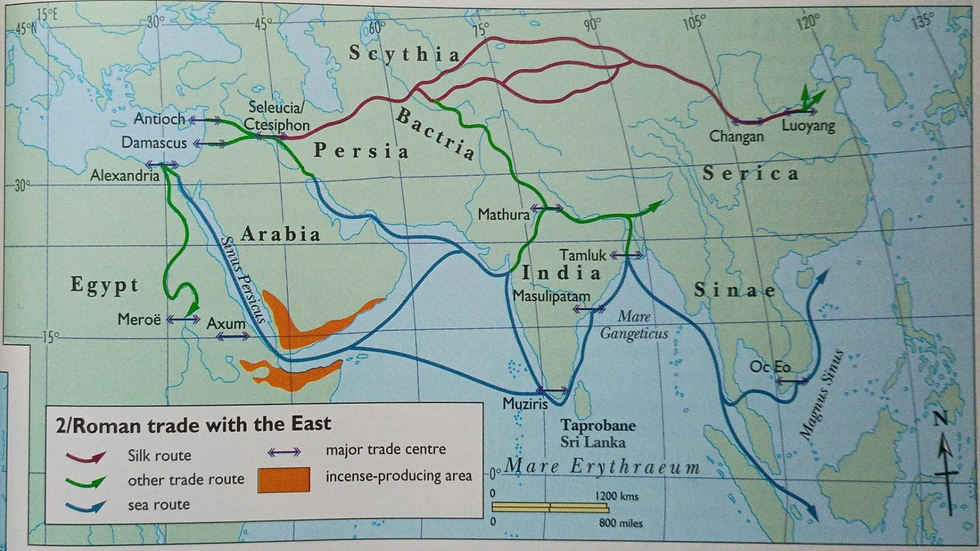
Roman Trade Reach: Photo from: The Penguin Historical Atlas of Rome by Chris Scarre
Rome solidified the trade routes with an uncharacteristically peaceful conquest of the Nabatean empire, based in Petra. It held multiple contracts and logistical lines for the growing SE Asian-Roman trade network. Rome annexed the “middle man,” as it were, and soon after 106 AD began maritime anti-piracy patrols to maintain the economic flow. This began the lineage of empires and nations dependent on the trade network to look to the Somaliland region as more than a source of exotic goods. It also sets a pattern oft repeated in history: The “Routes and Resources” require military protection, and “middle men” not controlled must eventually be brought under control. Somaliland and the region had now evolved for Rome and its imitators into a “hinge” position—critical real estate linking the Red Sea, the Indian Ocean, and beyond.
While Rome never built garrisons in Somaliland, it did maintain a form of naval power along the trade route, based for a time on the island of Farras. A Latin inscription dated to 144 AD, discovered on the islands, confirms the presence of a Roman garrison, specifically a vexillatio (task force) of the Legio II Traiana Fortis and auxiliary troops. This garrison was established under Emperor Antoninus Pius and served as a strategic military and administrative base in the southern Red Sea, near the modern border of Saudi Arabia and Yemen.
The site, known as Portus Ferresanus, was likely used to secure maritime trade routes, particularly those connecting the Roman Empire with the Indian Ocean. It was positioned 1,000 km south of Berenice, the nearest Roman port in Egypt, and remained the empire’s most remote outpost until its fall during the Arab Muslim conquest.

Photo: Location of the Roman Garrison of Portus Ferresanus
During this period, a critical but non Roman port city of Zeila, on the northwestern coast of Somaliland near the border with Djibouti, was established. Zeila plays a central part in Somaliland’s historical record. Known as Avalites or Avalite in Greek and Roman texts, and identified by the Jewish traveler Benjamin of Tudela as the Biblical location of Havilah. During the Roman period, Zeila was already a vital stopover for merchants hauling amber, leather, and frankincense from the African interior to Arabia, Persia, and beyond. Zeila would appear many times in the continuing saga of Somaliland and trade route control long after Rome had left. During the medieval period (See below), from the 13th century, the Ifat Sultanate (c. 1285–1415) made Zeila their coastal crown jewel, controlling trade routes that linked the Ethiopian highlands to the wider world.
Ifat’s successor, the Adal Sultanate (c. 1415–1577), used Zeila as a base for wars of religion and ideology against Christian Ethiopia—mirroring the dynamics Ahmad ibn Ibrahim al-Ghazi’s conquests in the 16th century.
By the 19th century, it had seen Egyptian Khedives, Ottomans, and British occupiers—finally becoming part of British Somaliland in 1888 as a strategic coaling station.
(*Today, Zeila is in Somaliland’s Awdal region, a far cry from it’s glory days with ruins of mosques, minarets, and Ottoman-era buildings and witnessing clan tensions like recent Gadabursi-Isse instead of bustling trade.)
CHRISTIAN
As the Roman Empire adopted a singular religion, ideology began to become a factor in the trade routes. The Roman and later Byzantine Christian empires began to incorporate religion as a mechanism of state power, if only to help unite and in some cases pacify both internal and peripheral populations. North of Somaliland in what is now Ethiopia and Eretria, there arose a Christian empire known as Askumite Empire. The Empire converted to Christianity when a man named Frumentius from Tyre in Lebanon converted Askumite King Ezana in the mid 4th Century AD, and much of the Empire with him. This continued to solidify the connections between Askuma and Rome, in addition to trade.
“The Aksumites took full advantage of these commercial opportunities. Gold and ivory were perhaps their most valuable export commodities, but they also trafficked in tortoise shells, rhinoceros horns, frankincense, myrrh, emeralds, salt, live animals, and enslaved people. In exchange, they imported textiles, iron, steel, weapons, glassware, jewelry, spices, olive oil, and wine. Their trading partners included most of the major states in the known world: Egypt, South Arabia, the Middle East, India, and China. Perhaps their most important commercial partners were the Byzantine Romans. Aksum was the first African country to mint its own coins—in gold, silver, and bronze—all in the standard weight categories issued by the Roman Empire. These coins have been recovered in multiple foreign locations, including as far away as India.” - National Geographic https://education.nationalgeographic.org/resource/kingdom-aksum/
However, across the strait in Yemen, there emerged around the same time an ally of the Sassanian Persian Empire that would see the region used as a proxy battleground for larger empires. In what is now Yemen, King Abu Karib As’ad, converted his kingdom of Himyar to Judaism and became embroiled in a generational battle with the Christian Askumite Empire across the Red Sea. Himyar’s Dhu Nuwas (r. c. 517–525 AD) invaded and massacred Christians in Najran, allying with Sassanian Persia against what he perceived to be Byzantine proxies.
According to multiple sources, including the Martyrdom of Arethas and the Book of the Himyarites, the Christians were captured, promised safety, and then executed—some burned alive in trenches—after breaking a sworn oath. The massacre is estimated to have killed 12,500 to 15,000 Christians, with reports of churches being burned and Christian leaders’ bones exhumed and destroyed.
This event triggered widespread outrage in the Christian world. The Byzantine Emperor Justin I appealed to the Christian Aksumite King Kaleb, who launched a military invasion of Himyar in 525 AD.
Aksum’s King Kaleb struck back, conquering Himyar in a “Holy War” that also served as the later Crusades did against Islam, as a mechanism to solidify trade routes and resources. The Christian Aksumite forces defeated the Jewish King Dhu Nuwas, leading to his death (by drowning or other forms of execution), the collapse of the Jewish Himyarite Kingdom, and the installation of a Christian viceroy, Sumyafa Ashwa. The invasion marked a pivotal moment in Red Sea geopolitics and religious conflict, ending independent Jewish rule in southern Arabia, weakening the Persian Empire’s potential to influence the Red Sea trade to Rome/Byzantium, and establishing Aksumite control for decades. Eventually the Aksumite Empire controlled what is now Yemen, Saudi Arabia, Ethiopia, Eretria, Somalia, and parts of Sudan and Egypt,
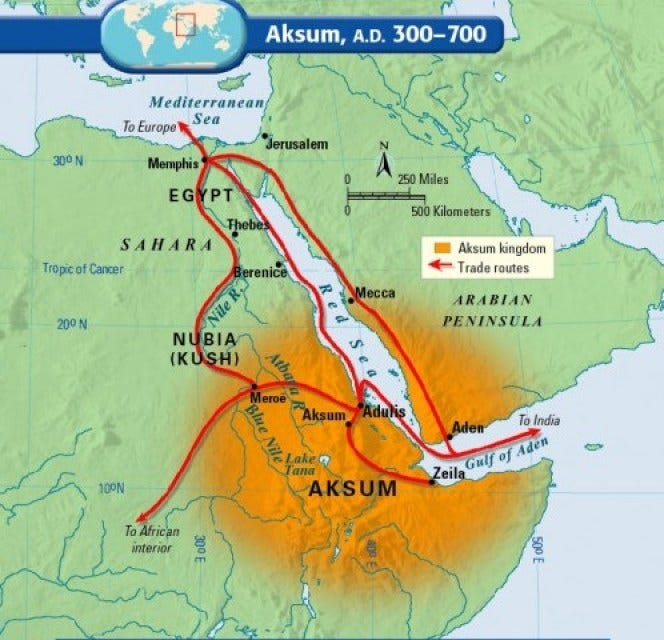
Somaliland’s coasts. Collateral transit zones for troops and goods, foreshadowing the region’s swing toward ideological extremes—religious binaries that spill over, eroding local control. Islam’s arrival via Arab traders in the 7th century flips the script, embedding Somaliland in Muslim networks and setting the stage for medieval sultanates.
Medieval Strongholds: Faith, Trade, and Imperial Shadows (7th–19th Centuries)
ISLAM
As Islam conquers much of the Roman Empire it both assumes previous trade routes and begins to plant the seeds of Islamic ideology and culture in Africa. During this transition period, Somaliland morphs into a Muslim bastion. To evaluate some clues about how Islam conquered Somaliland we turn again to the city of Zeila, where an early Mosque was built in the 7th century, possibly during or immediately after Mohammad’s lifetime. One account describes the growth of Islam in Somaliland:
“Indeed certain Arab reports suggest that for a period this ‘emporium of Habesh’ (Ethiopia) was an isolated Christian enclave on a coastline otherwise dominated by Islam. Half-a-century later, the inveterate traveler Ibn Battuta, whose first landfall on the African coast was Zeila, noted that its inhabitants were ‘black in colour and the majority of them are Rafida’ (literally ‘deserters’, a pejorative term used by Sunni Muslims to refer to Shi’ites, who rejected early Caliphs such as Abu Bakr.)… Oral tradition indicates that Islam took a strong foothold in the Somali interior between the 10th and 13th cents. The existence of trade routes inland from ports such as Zeila and Berbera doubtless influenced this spread, but the main factor, it would seem, was the [proselytizing] efforts of several legendary sheikhs (a term referring to a religious teacher or revered leader) who originated in Arabia and settled in Somalia to found clans and subclans that are still integral to Somali society today… In the late 13th cent., Zeila became the focal point of the Ifat sultanate, an Islamic empire ruled by the Walashma dynasty that extended across most of present-day western Somaliland into Djibouti and parts of eastern Ethiopia. Founded by the Umar Walashma, Ifat supported an important trade network, with Zeila serving as the coastal terminus of an inland caravan route that followed a string of substantial Islamic settlements to and from the inland emporium of Harar, in eastern Ethiopia.”
It is easy to see how Ifat Sultanate (1285–1415 AD) and the succeeding Adal Sultanate (1415–1577 AD) were dominating Zeila’s trade lanes. These powers were in conflict with Christian Ethiopia, peaking in Ahmad ibn Ibrahim al-Ghazi’s 16th-century invasions that overran much of Abyssinia.
OTTOMAN
The Ottomans claimed loose suzerainty from the 16th century onward, serving as a buffer against Europeans and Ethiopians, but clans like the Isaaq and Dir seem to have held effective control. This era echoes Yemen’s divides, with the trade ports the focus of the main international power, leaving a degree of local control and continuity to the Somali clans.
Enter the Europeans: Portuguese fleets under Vasco da Gama bombarded Zeila in 1541 to smash Ottoman-Arab monopolies, aiding Ethiopia and marking the West’s Horn debut.
BRITAIN
The Suez Canal’s 1869 opened more pressure from Britain to involve itself in Somaliland’s politics and future. Britain snatched Somaliland from Egypt in 1884, creating clan treaties (Isaaq, Gadabuursi, Warsangeli) and forged British Somaliland as an India-bound coaling hub, fending off French Djibouti and Italian Somalia (seized in 1889). The Dervish revolt (1899–1920) under Sayyid Muhammad Abdullah Hassan put pressure on the British colonial rule but was eventually was crushed.

PHOTO: With the Mad Mullah of Somaliland. https://mogadishuimages.wordpress.com/2012/07/29/1903-drawings-of-british-in-conflict-with-sayid-maxamed-cabdille-xasan/#comment-235
Colonial Fractures to Independence Gamble (19th–Mid-20th Centuries)
WWII saw the vulnerability of the existing control lines between competing foreign owners on opposite sides of Somalia and Somaliland: Italy and Somalia invade and conquer British Somaliland in but shortly Britain reclaims it by 1941, seeing little action for the remainder of the war.
Post-war, the patchwork of Somali territories (British, Italian, French, Ethiopian, Kenyan) fuels pan-Somali movements, fed by Soviet influence agencies attempting to place a mask on Red Colonialism by branding it as “anti colonial”. Eventually Britain releases colonial control of Somaliland on June 26, 1960, and a few days later on July 1 it merges with Italian Somalia into the Somali Republic. While this unity appeared to make sense on paper, deep clan rifts such as the infamous Darod vs. Isaaq/Hawiye are factors in the friction points that will eventually rupture into an independent breakaway Somaliland in 1991.

Photo: Iain Norm MacLeod in 1960 Source https://saxafimedia.com/1960-somaliland-govt-somalia-didnt/.
Detective Sidebar: Note on Clan DynamicsSomalia and Somaliland may appear to outsiders to be unified in language, the reality is deep divisions. There are six major clans and a number of smaller minority groups. The major clans are Darod, Hawiye, Isaaq, Dir, and Digil-Mirifle, and Rahanweyn. Many Somali’s and Somalilanders see themselves in terms of clan affiliation vs. a national identity. See link above for more on clan dynamics and politics in Somaliland.
Take the case of Mohamed Siad Barre (6 October 1919 – 2 January 1995), a shrewd Darod clansman from the Marehan sub-clan, who orchestrated a bloodless coup on October 21, 1969, just days after the assassination of President Abdirashid Ali Shermarke amid widespread accusations of electoral fraud and corruption in the fledgling democracy.

Photo: Mohamud Siad Barre. From Soviet to US puppet. Eventually cast aside by both Empires and forced to flee as his “Scientific Socialism” collapsed around him and the ancient clan structure re-asserted itself.
Proclaiming “Scientific Socialism” as his ideology, Barre suspended the constitution, dissolved parliament, and rebranded the nation the Somali Democratic Republic, drawing heavy inspiration—and arms—from the Soviet Union and its Cuban allies.
Under this blood red banner, he launched multiple radical reforms: nationalizing industries, boosting indoctrination via controlled literacy in rural campaigns, and ballooning the military from a modest 10,000 troops to a staggering 300,000 by 1990, equipped with Soviet tanks, MiG jets, and artillery.
However this “Scientific Socialism” had factors that normal USSR puppet masters did not usually contend with. Barre stacked the ranks with loyal Darod and Marehan kin, sidelining other clans and weaving a web of nepotism that poisoned the state’s foundations. Communism was on the flag and slogans, but the ancient clan system was still running the engine of government and getting the spoils.
These friction points widened dramatically with the Ogaden War of 1977–1978, an expansionist gambit where Barre’s forces invaded Ethiopia’s Somali-inhabited Ogaden region in July 1977, capitalizing on Ethiopia’s internal turmoil after the fall of the Christian Emperor Haile Selassie.
Initially triumphant, Somali troops overran vast territories, fueled by pan-Somali nationalism and dreams of a Greater Somalia—but the “brotherhood of communism” proved a cruel myth when the Soviets, prioritizing their new Marxist ally in Ethiopia, flipped allegiances in a massive betrayal, airlifting Cuban troops and flooding Ethiopia with $1 billion in arms.
By March 1978, Somalia’s army was routed, leaving 8,000 dead, a flood of refugees straining resources, and Barre’s regime humiliated and isolated.
Desperate, he pivoted westward, expelling 6,000 Soviet advisors and cozying up to the United States in 1978, securing military bases like Berbera in exchange for American aid—part of a Cold War realignment that brought in billions from donors including Italy, Saudi Arabia, and France.
Detective Sidebar:The Betrayal Blueprint – The history of the Barre Socialist regime period is a “classic case file” of authoritarian overreach: Cold War pawns like Somalia get propped up by superpowers, only to crumble when the aid tap runs dry or the Oligarchs shift ledgers around. The Ogaden fiasco demonstrates this pattern clearly, with clans as the ultimate casualties. These conditions still echo in today’s Somaliland region—nothing new under the sun.
Yet this lifeline bred rampant corruption: funds vanished into phantom projects, like Italy’s infamous $70 million fertilizer plant that never materialized, while officials siphoned aid for personal villas and Swiss accounts, deepening poverty and resentment as the economy cratered under war debts and mismanagement.
Repression escalated to barbaric heights in the 1980s, as Barre clung to power through a network of secret police and clan militias; the pinnacle of horror came in 1988, when the Isaaq-led Somali National Movement (SNM) launched daring assaults on northern cities like Hargeisa and Burao in May, prompting Barre’s forces to unleash a genocidal campaign of aerial bombings, artillery shelling, and ground massacres that killed an estimated 50,000 to 200,000 civilians—mostly Isaaq—while displacing over a million and razing entire towns in what survivors dub the “Isaaq Genocide.”
By the late 1980s, with the Cold War thawing, the US suspended aid over human rights abuses, exposing the regime’s aid-dependent brittleness; clan-based opposition— from the SNM in the north to the Hawiye-dominated United Somali Congress (USC) in the south—coalesced, shattering the state in January 26, 1991 when rebels stormed Mogadishu, forcing Barre to flee south to his clan’s stronghold in Gedo before eventually escaping into exile in Kenya and later Nigeria, Somalia plunged into a power vacuum that was filled with warring clans.
During the warlord period in December of 1992, the US launched Operation Restore Hope. In support of humanitarian aid by the United Nations. However, shortly into the deployment, the US forces were tasked with arresting the Habr Gidr sub-clan of the Hawiye warlord Mohamed Farrah Aidid, who was also the leader of the Somali National Alliance (SNA) and had ordered the ambush and killing of 24 Pakistani UN Peacekeepers on June 5, 1993. In response, the UN Security Council authorized his arrest, and U.S. President Bill Clinton escalated involvement by deploying Task Force Ranger comprising Delta Force operators, Army Rangers, and other special operations forces under Operation Gothic Serpent in August 1993.
The overarching goal was to capture Aidid and dismantle his command structure to weaken his influence in order to restore order.
The Battle of Mogadishu erupted on October 3–4, 1993, when U.S. Task Force Ranger launched a precision raid in the heart of Mogadishu to capture two top lieutenants of Mohamed Farrah Aidid (Omar Salad Elmi and Abdi Hassan Awale Qeybdiid), who were meeting near the Olympic Hotel in Aidid’s Habr Gidr stronghold. Intended as a swift “snatch-and-grab” operation lasting about an hour, involving Delta Force operators, Army Rangers, 19 helicopters (including MH-60 Black Hawks), and a ground convoy of roughly 160 personnel, the mission quickly unraveled into the fiercest urban combat U.S. forces had faced since Vietnam.
Somali militiamen, armed with AK-47s and RPG-7s, shot down two Black Hawks (Super 61 and Super 64), forcing crash-site defenses amid thousands of armed fighters and civilians swarming the streets. Rangers and special operators held out through an 18-hour nightmare of ambushes, roadblocks, burning tires, and intense small-arms fire, defending the downed pilots and survivors until a massive multinational relief convoy—comprising U.S., Pakistani, and Malaysian troops—fought its way in the next morning to extract them. The raid tactically succeeded in capturing 24 SNA members, but at a staggering cost: 18 Americans killed, 73 wounded, one pilot (Michael Durant) captured (later released), and estimates of 300–1,500 Somali casualties, including many civilians. The graphic images of U.S. bodies dragged through the streets shocked the American public, prompting President Clinton to withdraw U.S. forces by March 1994 and contributing to the full UNOSOM II exit in 1995.
Detective Sidebar: The Irony Clue – Father vs. Son Across the LinesHere’s the twist: while Mohamed Farrah Aidid orchestrated the militia resistance that bloodied U.S. forces in Mogadishu, his own son, Hussein Mohamed Farrah Aidid was a naturalized US citizen and served as a US Marine Corps Artilleryman and translator! Hussein, who emigrated to California in 1979 at age 17, enlisted in the Marines in 1987, fought in Desert Storm, and deployed to Somalia in late 1992–early 1993 during Operation Restore Hope—the initial humanitarian phase—as one of the few fluent Somali speakers available, acting as a translator and liaison attached to UNITAF commander Lt. Gen. Robert B. Johnston. He even facilitated indirect communications with his father’s faction to ease aid flows, though he returned stateside by January 1993, well before the October raid. When Black Hawk Down unfolded on TV, Hussein watched in horror from California, describing a “black hole” inside him; the next day, a Marine commander asked him to draft a plea to his father for the release of captured pilot Michael Durant, which he did. Hussein later left the Marines in 1995, returned to Somalia after his father’s 1996 death, briefly led the SNA militia, entered politics (including as deputy prime minister), and remains a voice in the Somali diaspora.

Photo: US Army in Somalia during Operation Restore Hope. Source https://www.military.com/history/how-us-marine-went-somalia-and-became-warlord.html
SOMALILAND IS BORN (REBORN)
The Somali National Movement (SNM), an Isaaq-led rebel group founded in London in 1981, had been waging a guerrilla war against Barre’s regime for a decade, enduring brutal reprisals like the 1988 aerial bombardments of Hargeisa that killed tens of thousands and displaced over a million.
By early 1990, the SNM had already seized control of large swaths of the northwest, including key cities like Hargeisa and Burao, as Barre’s grip weakened.
With Barre’s ouster in January 1991, the SNM swiftly moved to solidify its hold over the region, capturing remaining government outposts and declaring a unilateral ceasefire to prevent the southern chaos from spilling northward.
SNM leaders, under Chairman Abdel-Rahman Ahmed Ali Tuur, rejected the interim government formed in Mogadishu by USC leader Ali Mahdi Mohamed, viewing it as yet another southern-dominated entity that marginalized northern clans.
Instead, they focused on internal stability, disarming militias and initiating talks with non-Isaaq communities, such as the Dir, Gadabuursi, and Harti clans, to forge a fragile peace amid lingering tensions from Barre’s divide-and-rule tactics.
The pivotal moment came in late April 1991, when elders, intellectuals, and representatives from across the northern clans convened the “Grand Conference of the Northern Clans” (also known as the Burao Conference) in the town of Burao, a dusty crossroads that became the cradle of a new nation.
From April 27 to May 18, over 500 delegates debated Somalia’s failed union, the horrors of Barre’s genocide against the Isaaq, and the desire for self-determination rooted in the brief five-day independence of the State of Somaliland in June 1960 before merging with Italian Somalia.
Drawing on traditional Somali xeer (customary law) and the influence of the Guurti (a council of elders), the conference culminated in a unanimous resolution on May 18, 1991: the revocation of the 1960 Act of Union and the declaration of the Republic of Somaliland, restoring the borders of the former British protectorate.
Tuur was appointed interim president, with the SNM’s central committee overseeing a two-year transition to civilian rule, emphasizing clan power-sharing to avert further bloodshed.
This birth of Somaliland wasn’t without birth pangs—sporadic clashes erupted in 1992 over resource disputes, and a brief civil conflict in 1994-1996 tested the fragile accord—but the Borama Conference in 1993 further entrenched stability by adopting a hybrid constitution blending democratic elections that hybridized clan-based organizational leadership.
CONCLUDING PERSPECTIVES
Again, there is nothing new under the sun. Like Iran and the Persian Corridor article we published last year (HERE), the same dynamics and many of the same players are at work in controlling critical geography in the Global Routes and Resources Game.
Nothing new under the sun.

Comments